The wax paintings
"The wax paintings" is a group of 11 works with a common theme.
Randomness is both, the theme and the creative process of these paintings.
The groping of the boundary between randomness and will, its acceptance and management are the core of each work. Each work palpates this quest in its own particular context and with an always specific topic of human concern: existential anguish, courage or attitude awards death, austery expressed through poetry, womanhood, self awarness, crime, love, the search of roots in the origins of the world, the fate of the age, refugeeism and the desolation of our environment.
Randomness is not only a thematic concern in the works but also a visual one. Essentially, a large part of their substance arises from randomness. Through the random forms that the wax traces on the paper, the artist tries to discover those stable forms that can give substance to the will and meaning to the work, that may integrate and perhaps tame randomness, if it can ever be done.
All paintings employ the same technique: wax, ink and acrylic colour on rough beige paper sheets of 100X70 cm.
The consistency as well as the thematic choice, concious but in the same time random, characterizes this collection giving it a common character, the strength of a unity, perhaps a small weapon of the artist against the uncertainity and fluidity of the random.
The wax paintings were exhibited in June 2025 in Athens.
This exhibition is humbly dedicated to my father Christos Psimoulis, who reconciled early on with all the uncertainties of a turbulent era. I am grateful to him for teaching me to observe, absorb, and create.
Introduction
Thirty years ago, eleven wax impressions were set aside, waiting for the moment when they would have something to say. A long incubation in the subconscious, as the search never truly settles. The completion of their final form in 2020 took a year and a half. With consciously strict discipline, I processed the impressions using a common expressive medium, size, and materials for all the works. A game of interaction emerged between the forms of the wax, the figures I chose to paint, and the concepts I explored, a canvas where I sought to capture randomness without denying its nature. Like every act of art, it was a gift of the soul that fulfilled an internal need, as well as a revealing process of self-definition.
Art bridges the ever-gaping void between the world of perception and the world of sensation. It is an enigma that, no matter how hard we try, whether as creators or as viewers, it never falls entirely within the realm of logic. Woven into the supreme Intelligence, the fabric of the world, the canvas of all mysteries, is also randomness. We may attempt to grasp and understand it, but we can never control it.
You, as observers, will discover in these works my own moments of randomness, and perhaps many others that I did not see myself. You will find no proofs, no answers, because it is precisely in this ambiguity that the magic of art lies.
As for me, I have now learned to navigate it. These wax paintings were, in a way, my salvation.
The Theme and the Work as a Whole
At the core of this artistic exploration is the question of “randomness”, the probing of the boundary between chance and will, its acceptance, and its management. Each work engages with this inquiry in its own unique environment, always with a specific theme. There are eleven themes that have preoccupied me: existential anxiety, courage or one’s stance towards death, the necessity of poetry expressed through simplicity, the nature of womanhood and its fate in the world, self-awareness, crime and our attitude towards it, love, the search for our origins in the dawn of time, the fate of old age, exile and the desolation of nature.
Randomness is not only a thematic concern in these works but also an artistic one. A significant part of their very existence arises from the element of chance.
The selected expressive mediums for these works are image, text, and symbolism. The materials used include wax, ink, and acrylic on brown paper. All works are 100x70cm in size.
Wax, as a material, presents a particular challenge in handling. It is not entirely controllable; it has a wilder nature than paint and often creates surprises. As such, it aligns more closely with the nature of randomness; fluid, unbounded, uncontrollable. Through the accidental forms that wax creates on paper, I attempt to discover the shapes that will give substance and meaning to the work. It is like a game in which randomness becomes either a partner or an adversary, and I try to incorporate it, to tame it, if that is ever truly possible. This experimentation becomes even more intriguing when the paper is illuminated from behind, transforming the image itself. Every element takes on a different expression under the changing light. For this reason, I consider it essential to present the works with backlighting, as this completes their full potential.
Ink is a more controllable material while maintaining its distinct character, which is crucial for the aesthetic rendering of the pieces; whether predominantly in black or, occasionally, in shades of red or blue. It was used to convey precision, especially in the smallest figures, and as a contrast of character and aesthetics to the wax. When diluted, ink becomes a colour that is not quite a colour, an attempt to express the ambiguity of things.
Acrylic serves as a balancing medium between the other two.
The forms
The forms in the works are created using all three materials simultaneously, and their appearance shifts when the piece is backlit. Light passes through the paper differently depending on whether an area is solely painted or also wax-coated. Some figures are clearly perceptible, while others teeter between reality and imagination, between completion and incompleteness. They often conceal symbolic meanings, though deciphering them is not necessary, even if they are closely tied to the theme of each piece. They simply exist as an intrinsic part of the work, emerging naturally in the creative process.
Some concepts crystallised at the inception of each work, while others arose during its execution. This is often the case, just as the artist creates the work, the work also creates the artist. They evolve together during the creative process, and the piece seeps into its creator. Randomness introduces yet another factor in this reciprocal relationship between artist and artwork.
The texts within the works function as artistic surfaces. I frequently use text as an artistic medium, a need arising from my connection to language. Here, the words are not randomly chosen; they are carefully selected to align with each work’s thematic core.
The choice of a black background, beyond its aesthetic harmony with the work, also carries symbolic significance. Black contains everything that is potentially ready to emerge at any moment, much like the offspring of randomness.
The consistency in execution and the thematic focus of these works, both intentional and open to the inevitable randomness that emerged, defines this collection. It gives it a unified character, the strength of cohesion, serving as a response to the uncertainty and fluidity of the random.
Originality in art is essential, as long as it does not defile it. There are four factors that all humans experience, which foster originality: lack, inexperience, error, and randomness.
Existentialism
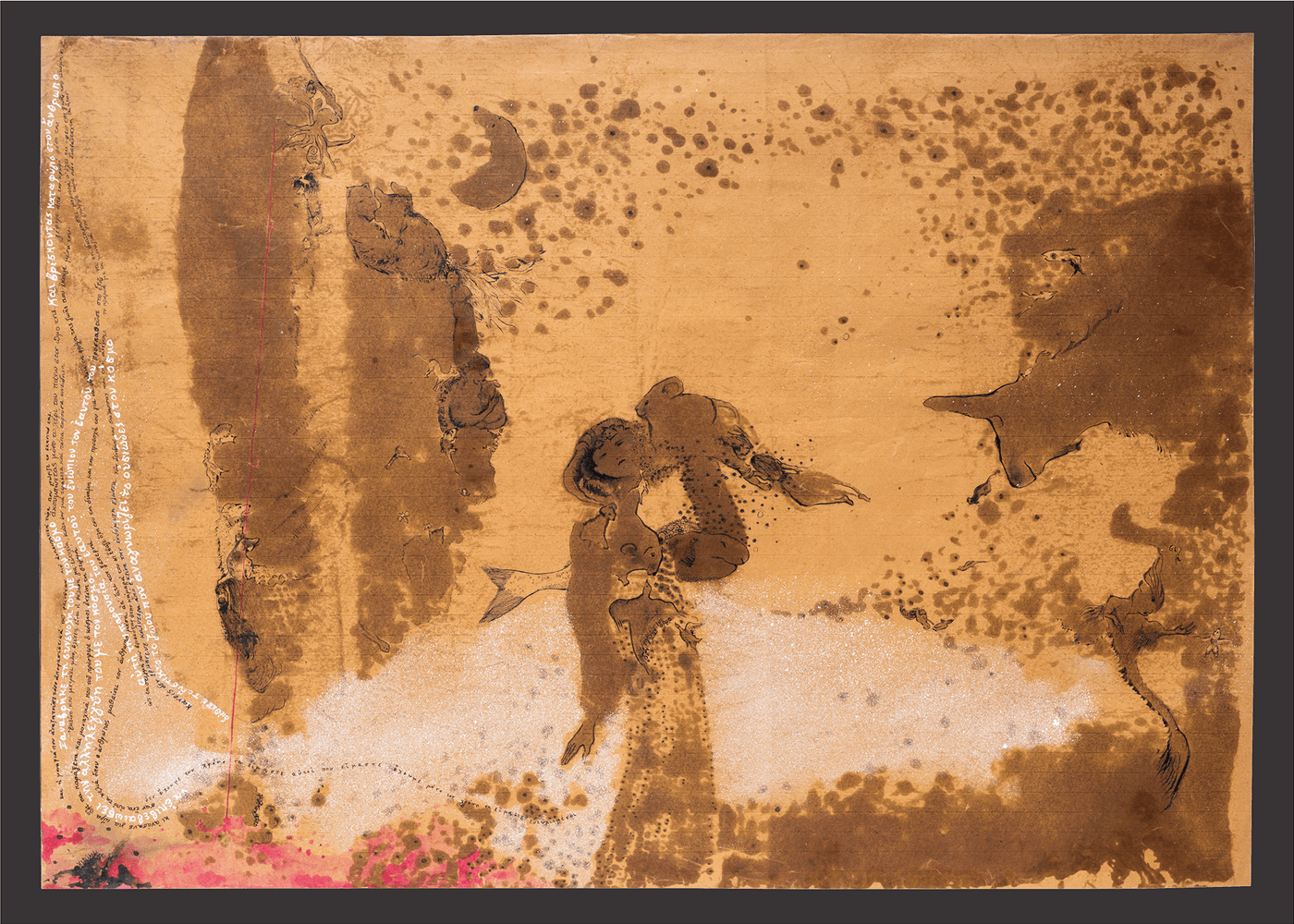
Thematic concepts
Existential inquiry is born with a human’s first breath. Its development depends on culture, maturity, and, of course, the role of randomness, which often serves as a guiding light along the way. Existential thought is embedded in all human expressions, from philosophy and religion to art and science. The timing of the question about life’s meaning and the way the answer is sought may vary, but the question is always posed, and humanity is always in search of an answer.
Symbolism
The coexistence and pairing of real or imaginary beings with humans indicate the realm of searching for life’s meaning, while the red ink symbolises life itself. Depicted are fish, mammals, birds, as well as water and earth spirits, while the girl wears or has horns on her head, primitive symbols of power and wisdom.
The texts are by Albert Camus.
---
Courage or the relationship to Death
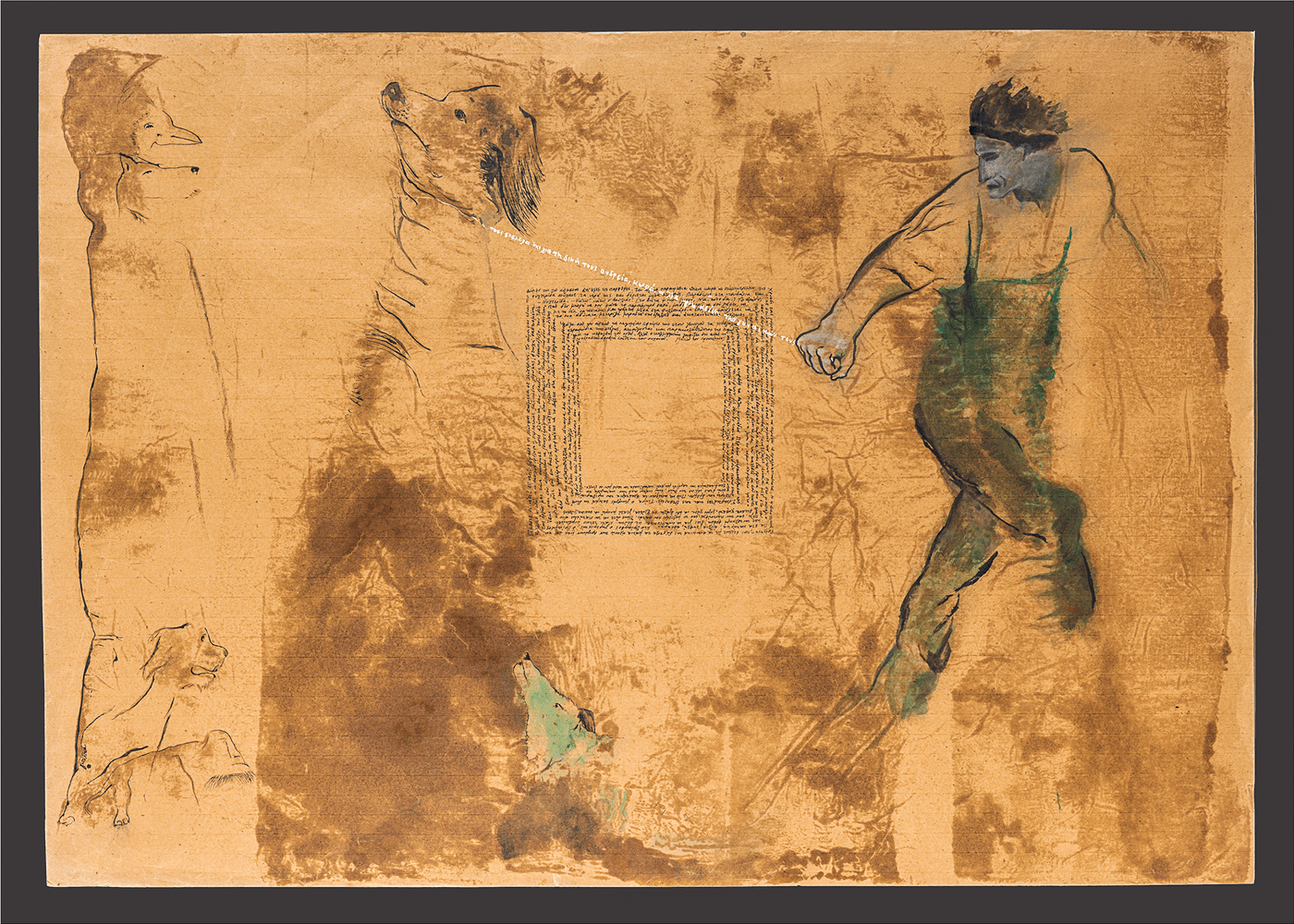
Thematic concepts
How does a person face death? Is courage the defining element of one’s stance toward death, or is it sometimes tied to ignorance, stoicism, or conscious choice? Perhaps courage cannot exist without the imminent presence of loss. We often consider it among the greatest virtues, but is it only that? Is it a matter of logic or an existential approach? Does it hold meaning, defining humans, or is it defined by them? How much courage does fate unfold for a person, and how much can they withstand within the fabric of their own life?
Symbolism
The male figure may represent a warrior urging others to follow, or a laborer toiling, or even death itself, extending its hand to reap lives, or fortune who sows fate. The face is deliberately visually distinct from the rest of the body, signifying transcendence. The dogs are reinterpretations of Cerberus and as such they are tamed by the linear proposition that works like a leash. It is a reference relating not to the courage of the warrior, but to the deeper courage of the individual who knows they will endure loss. The text is clearly framed within the intense symbolism of the square. Ultimate courage seeks to defy death.
The texts within the square are by Stratis Myrivilis and Steven Pressfield.
---
Poetry
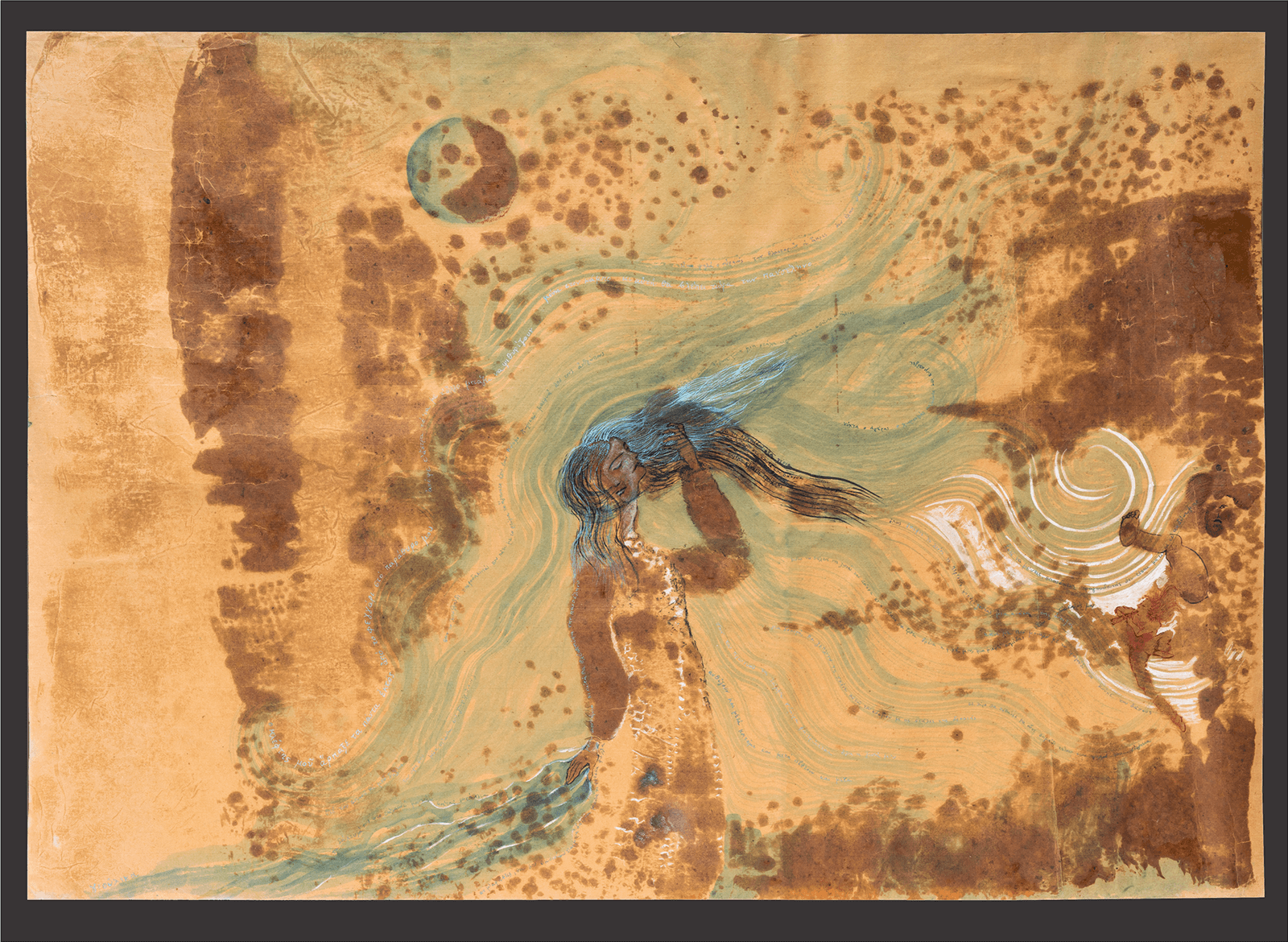
Thematic concepts
Poetry is the memory and wisdom of humankind. Everything resides within it. To be initiated into poetry is to be initiated into life. In mature societies, poets are held in esteem and respect, and their work serves as a beacon for future generations. Poetry possesses a divine grace, which is why it becomes the key to the world, its very breath. In poetic expression, words are chosen with extreme care, their conceptual relationship, tone, and composition are of paramount importance. In the Japanese Haiku form, minimalism is added to this equation. Poetry, in what is perhaps its most concise form, captivates through its simplicity and depth.
Symbolism
Poetry, in the form of Haiku, appears as a movement emerging from both, nature and humanity. A small child figure with a flute in the lower right corner symbolises its purity and musicality.
The texts include Japanese and Greek Haiku poems.
---
Woman
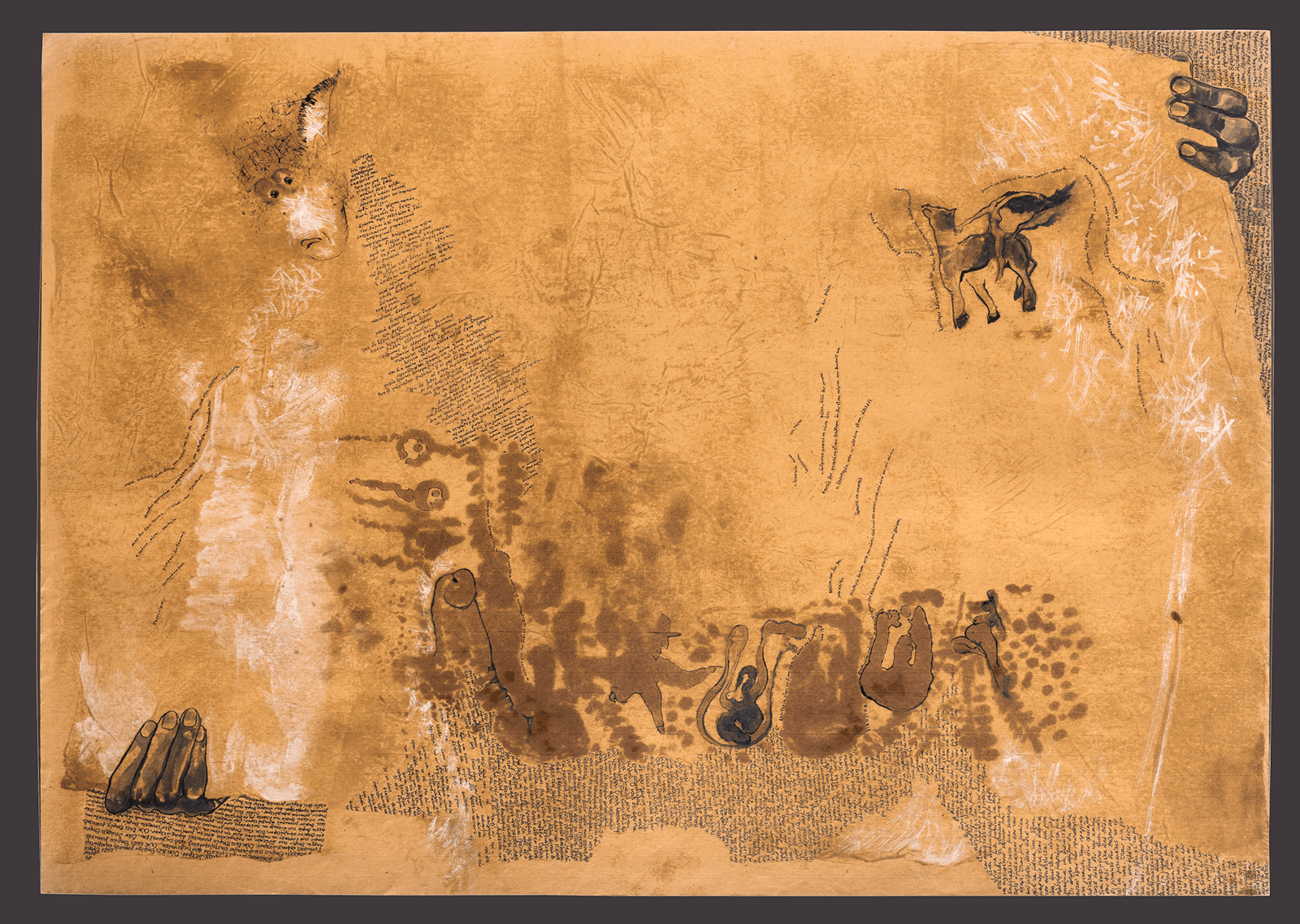
Thematic concepts
Over the centuries, the fate of women has differed from that of men. Even in societies where individuals shared mutual respect or were warriors of survival, nature set women apart by choosing them to bear life. Chance is always present in women’s lives, shaping their social status, acceptance or rejection, motherhood or barrenness, worship or abuse, equality or servitude. It varies case by case, depending on traditions or legislation, but it is always there. Sometimes it is fatal, sometimes redemptive, but it always accompanies their journey.
Symbolism
A grotesque figure in the upper left corner contemplates the position of women and glances sideways at the texts of Aristophanes. Diagonally opposite, in the upper right corner, at the base of the image, there is a phallus, a womb, a pregnant woman, and a hurried male figure who visibly points or showcases something. The hands that frame the events, as if holding an image within the image, symbolise the nature of the quest as primarily a social issue, one that is thus «presented» as such.
The texts are from Aristophanes, while the names in the upper right corner belong to Amazons.
---
Self - Knowledge
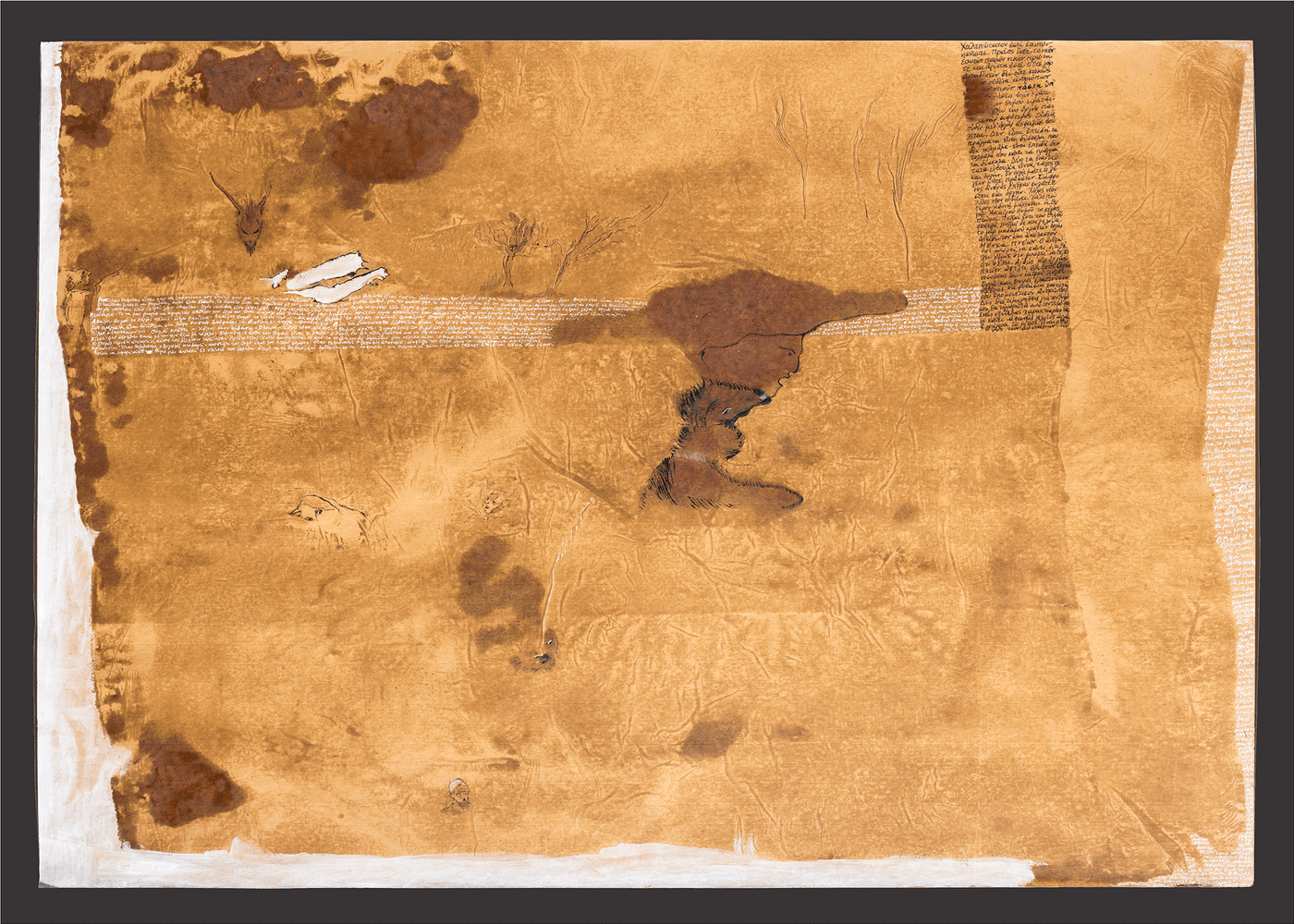
Thematic concepts
The path of the human mind in search of self-knowledge is a long one. We often make mistakes, believing we are doing something great and admirable, only to become participants in a hellish pride or refuse to accept our faults. Yet, within this illusion, our inner connection to a higher world always keeps watch. Fate sometimes plays a decisive role in our relationship with our inner self. Even when we ignore it, out of stubbornness or ignorance, it returns, faithful to its unbreakable, primal bond with the call of the self, often awakening our consciousness. With the soul’s cracks left open, fate facilitates self-awareness and, with it, redemption. It is the ticket to the one journey a person truly takes, the journey within.
Symbolism
The figure appears angry. Αwareness and management of anger are closely linked to the process of self-knowledge. The presence of the animal within the figure signifies the coexistence of this other self, which remains until self-knowledge gifts the individual their one true identity. Various other figures accompany this search. The artwork seems to float aimlessly, like a second work within the work, until self-knowledge bestows upon it the stability it seeks.
The texts are by Aristotle, Aeschylus, Sophocles, Euripides, Plutarch, Basil the Great, Thucydides, Chilon of Sparta, Homer, Friedrich Nietzsche, Democritus, Solon, Plato, Seneca, Pythagoras, Heraclitus, and Arthur Schopenhauer.
---
Crime or the free will
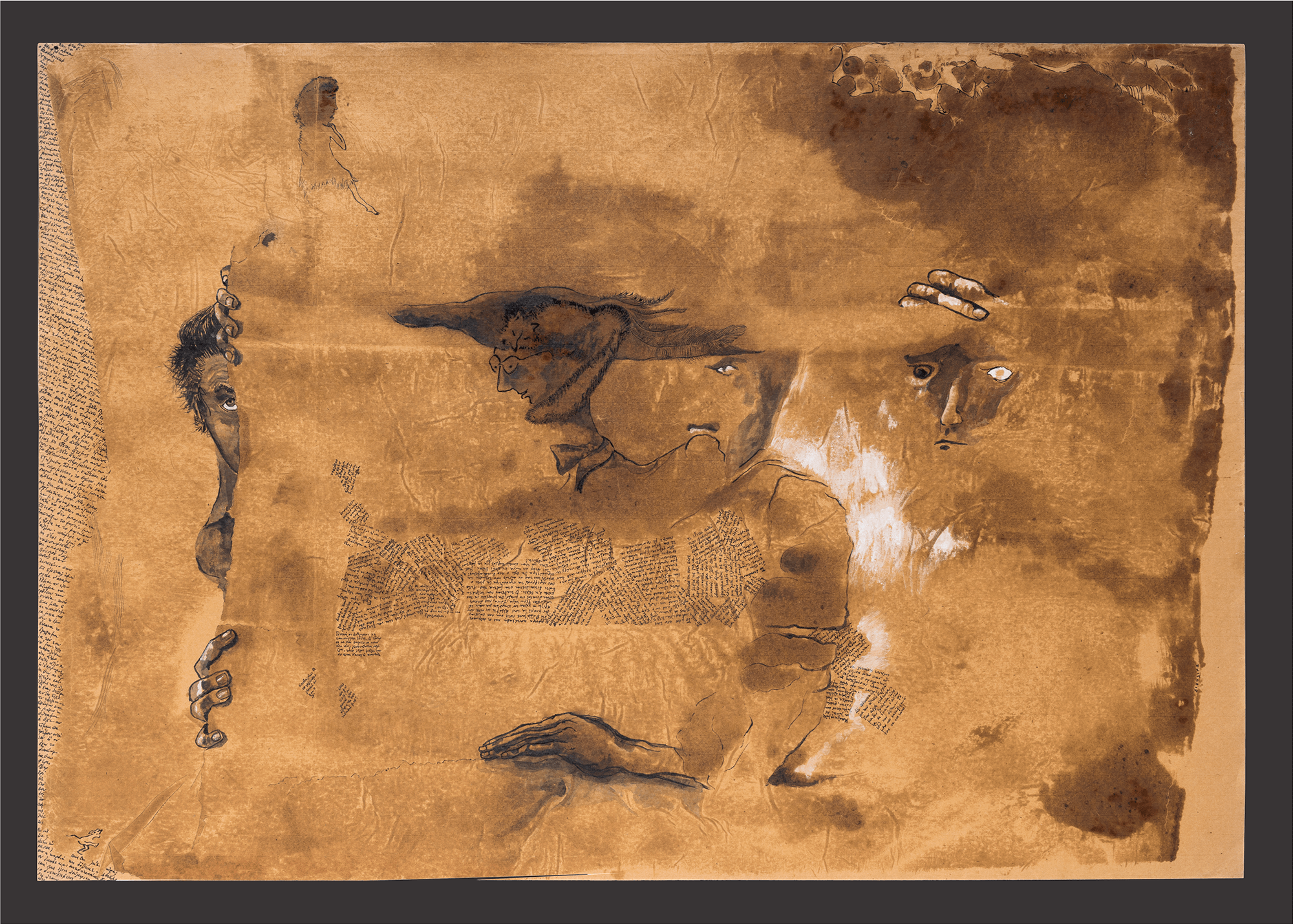
Thematic concepts
There is no salvation from crime without spiritual dignity. We are all accountable for a crime, and we are all connected. Do we ask ourselves before any action what we truly wish to do, and do we reflect afterwards on what we have actually done? Rejection does not correct the guilty. Logic does not redeem. Crime seeks redemption and the acceptance of guilt is the way. Sin lies in the betrayal of the self, and its magnitude is measured against the innocence of the victim. Justice and catharsis are two different worlds. In justice, chance is often decisive; in catharsis, only personal pain matters. All who are damned, by arrogance ignore the signs of fate, even as it wisely shows them the path to redemption.
Symbolism
This piece draws inspiration from Dostoevsky’s “Crime and Punishment”. The central figure, if perceived as a woman, represents the victim Lizaveta. Perceived as a man, as the glasses symbolise the search for truth, the figure refers to the inspector. The male figure with the intense gaze represents Raskolnikov, the embodiment of both, the criminal act and the free will. Sonia is depicted as a young girl, almost childlike, symbolising purity. Her suspended barefoot step, bare not only due to poverty but also due to the world’s sins, symbolises the saving, difficult step towards redemption. The hands are symbols of action.
The texts are by Fyodor Dostoevsky.
---
Theogony: The Genesis of the World
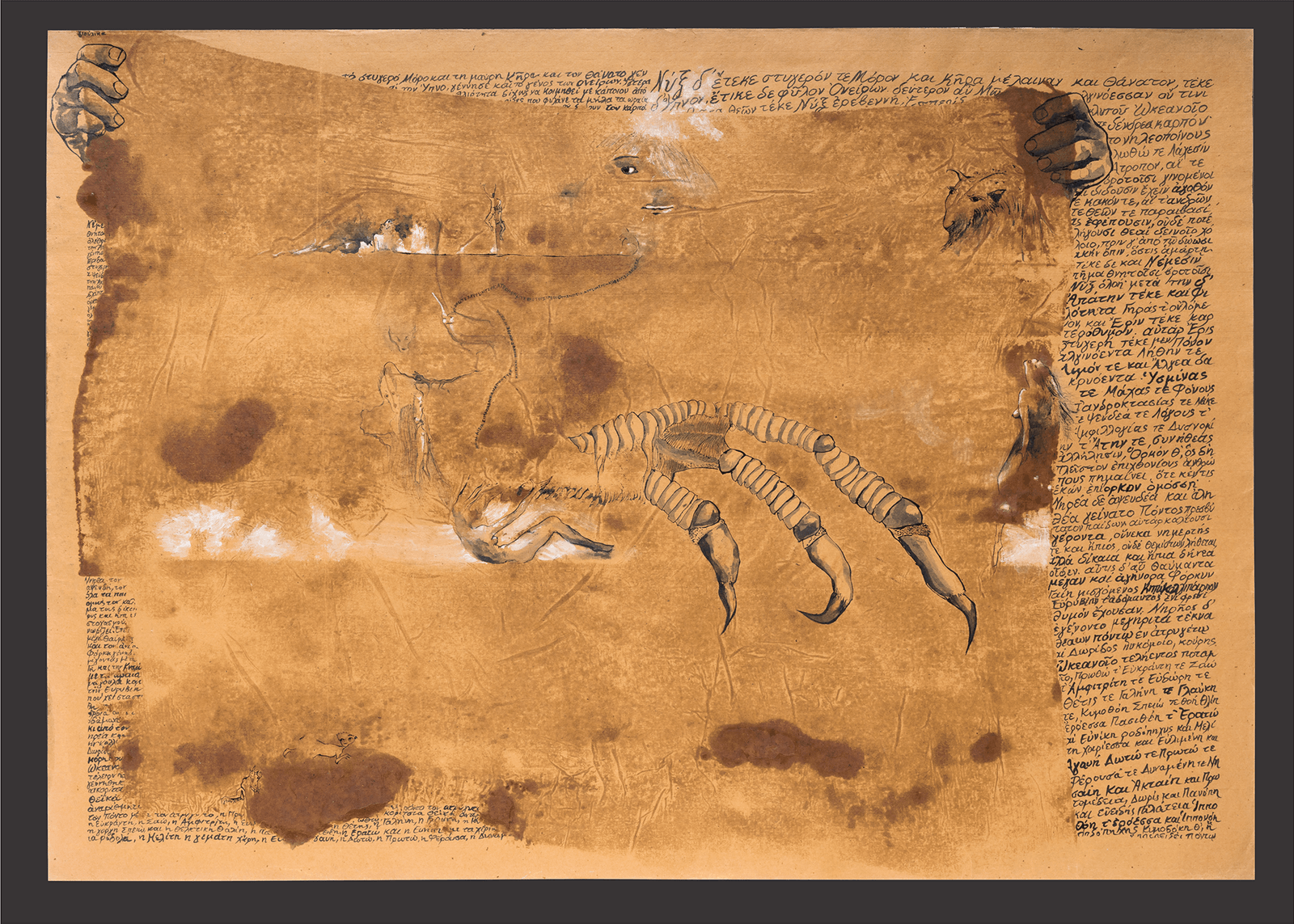
Thematic concepts
The search for origins and the birth of the world, where chance played a decisive role, has fascinated me since childhood; rather as quoted by mythology and especially that of Hesiod, than science. Cosmogonic myths contain the wisdom of the world. From the eternal nature of things, the souls of beings, and their transformations, to concepts of respect, mindful use, moderation, and ethics, back to chaos, the first diffuse matter, the substance of creation, the material of genesis. All archetypes are born with the cosmogonic myth. Every word and description offers material for creation, serving as both a source and a key to understanding the world. The forms are infinite, and so is the eternal quest.
Symbolism
The cosmogonic myth is delivered to us as a “piece of work” by two noble hands. These are the hands of the poet, and the work is Hesiod’s Theogony, a piece with countless beings, for which only symbolical reference can be made with the figures of monsters, animals, Naiads and Nereids.
The text is the beginning of Hesiod’s Theogony.
---
Love
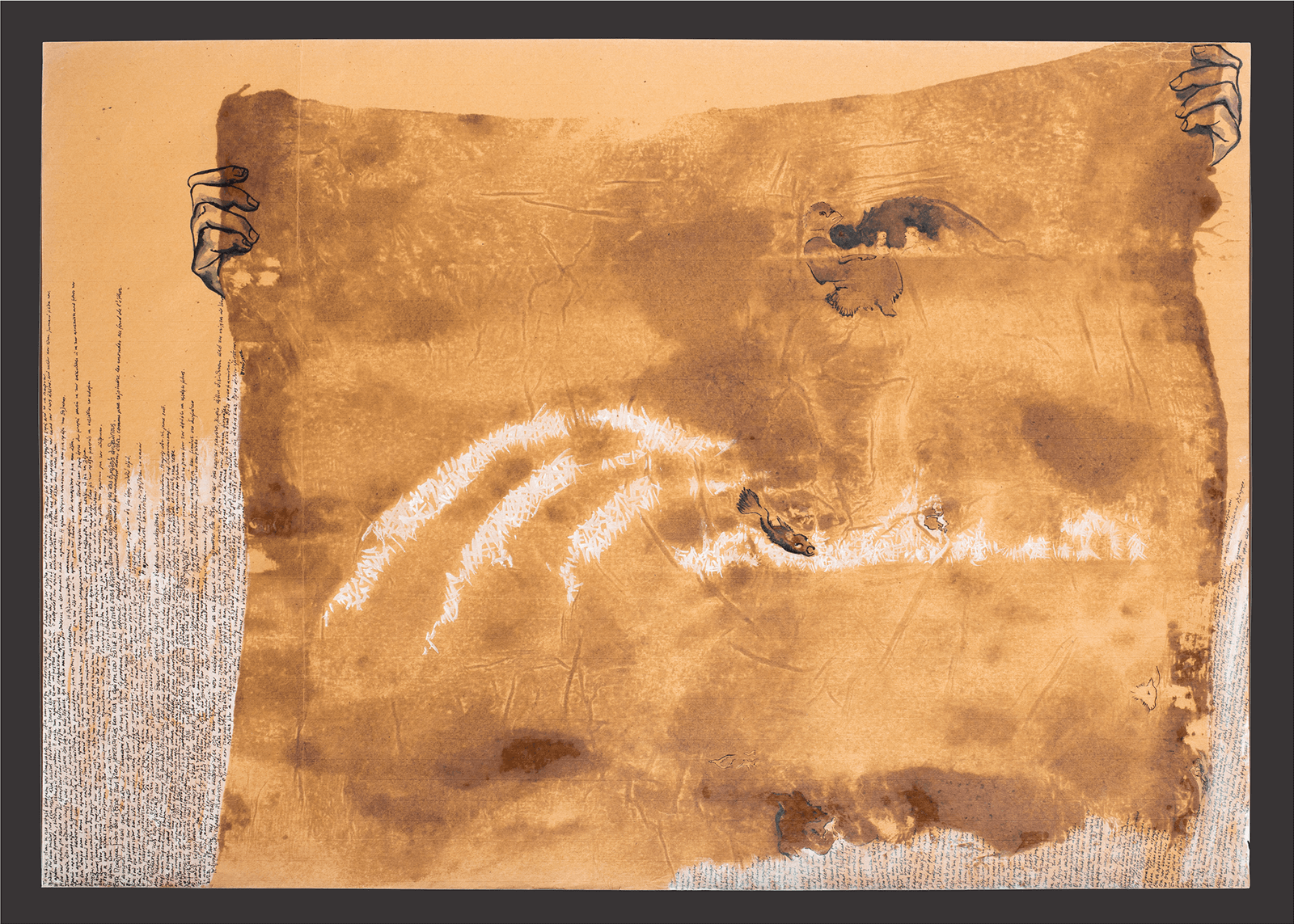
Thematic concepts
Love is a decision, a way of life. Loving for a moment can be a matter of chance. Loving with persistence requires courage, altruism, consistency, gentleness and compassion. Compassion is empathy, it coexists with love. It is related to our behaviour. Love knows neither place nor time. It is the opposite of pragmatism because it is sacrifice. It is tied to the meaning of life. What connects them is that behaviour is interwoven with life’s meaning. It does not matter what we achieved or failed to accomplish in our passage through life, but how we treated one another. Love is a conscious struggle. Chance may influence it, but ultimately, it is our consciousness that decides. Love is free will.
Symbolism
The hands offering love have a tender expression, reflecting its very nature. The somewhat aggressive shape in the centre, reminiscent of predatory claws, is framed by a fish, a symbol of life, divine salvation, and good fortune, along with other small creatures, perhaps mismatched yet beloved. Thus, evil is stripped of its demonic nature, as love triumphs over it without causing harm.
The texts include writings by Erich Fromm, F. Scott Fitzgerald, Charles Baudelaire, Bertold Brecht, Apostle Paul, Oscar Wilde, Federico García Lorca, Sappho, and Julika Psimouli.
---
Obasute: the fate of old age
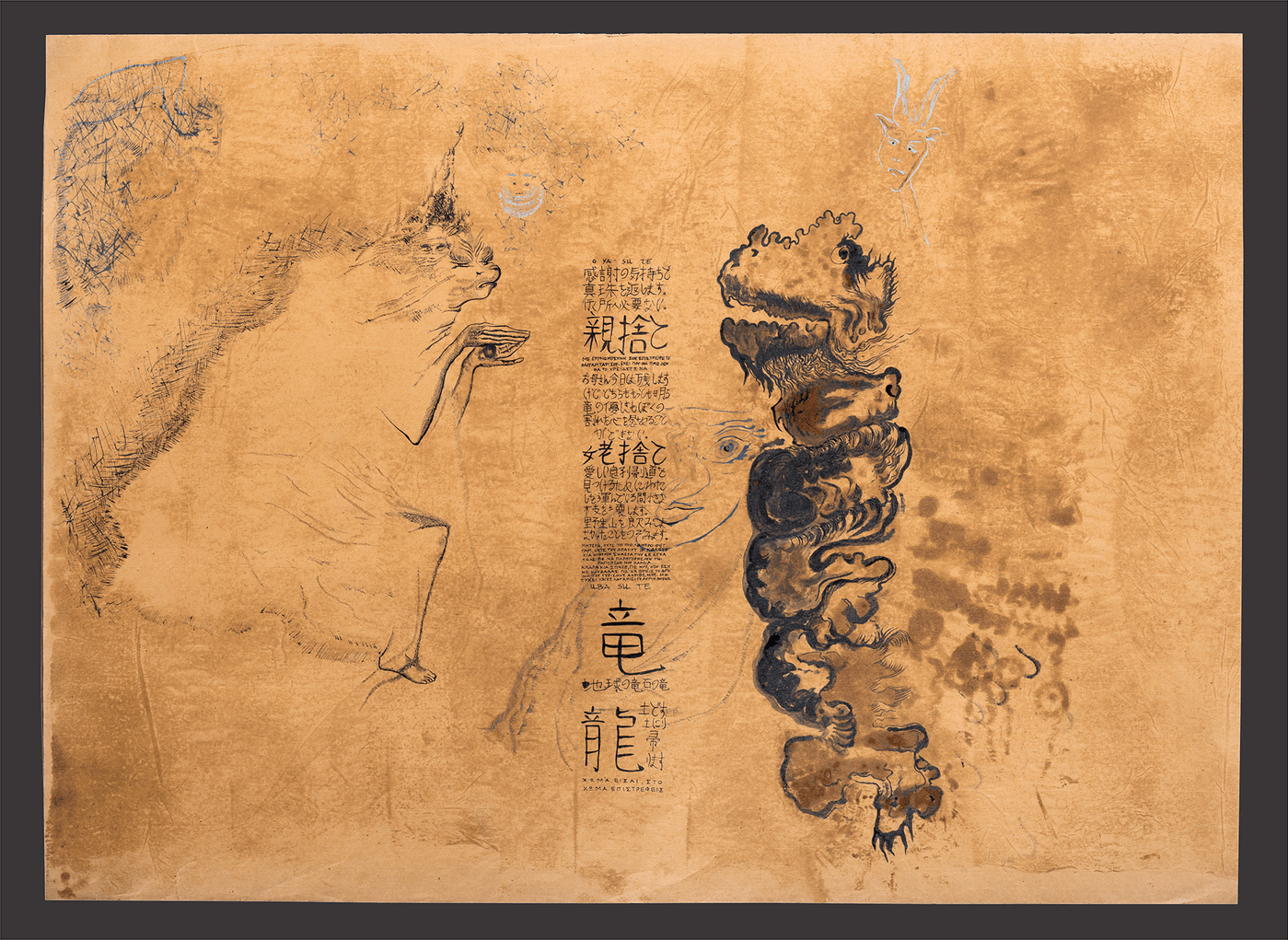
Thematic concepts
In old age, a person often becomes untethered. He grows more generous with time, attention, and love. He forgives. He reminisces, revaluates and occasionally revises. He accepts. He shows courage. Sometimes, he embarks on new paths. He understands more deeply the mystery of life. He prepares for the epilogue. How does society treat the elderly, and how do they perceive themselves? From ancient India to the tales of Yamato, from Mount Kamuriki to Mount Obasute or the Ubaishi, the rock of the old woman, there has never been a single, clear path. This work focuses on the Japanese phenomenon of Obasute and the mixed emotions it evokes.
Symbolism
The earth’s dragon stands calmly and peacefully on the right, a symbol of the earth that will posthumously reclaim the body. Opposite it, an oversised figure, equal in stature to the dragon, part human, part fairy, represents old age accepting the end and returning the pearl to the dragon, a symbol of life, prosperity, purity, love, and good fortune. Between them, there are three sayings: in the first, an excerpt from a Haiku poem from the legends of Prince Yamato, the mother speaks to her son; in the second, the mother addresses the dragon; and in the third, the dragon speaks to the mother. These represent the three stages in the dialogue of transition.
The texts are in Japanese and Greek.
---
Refugees
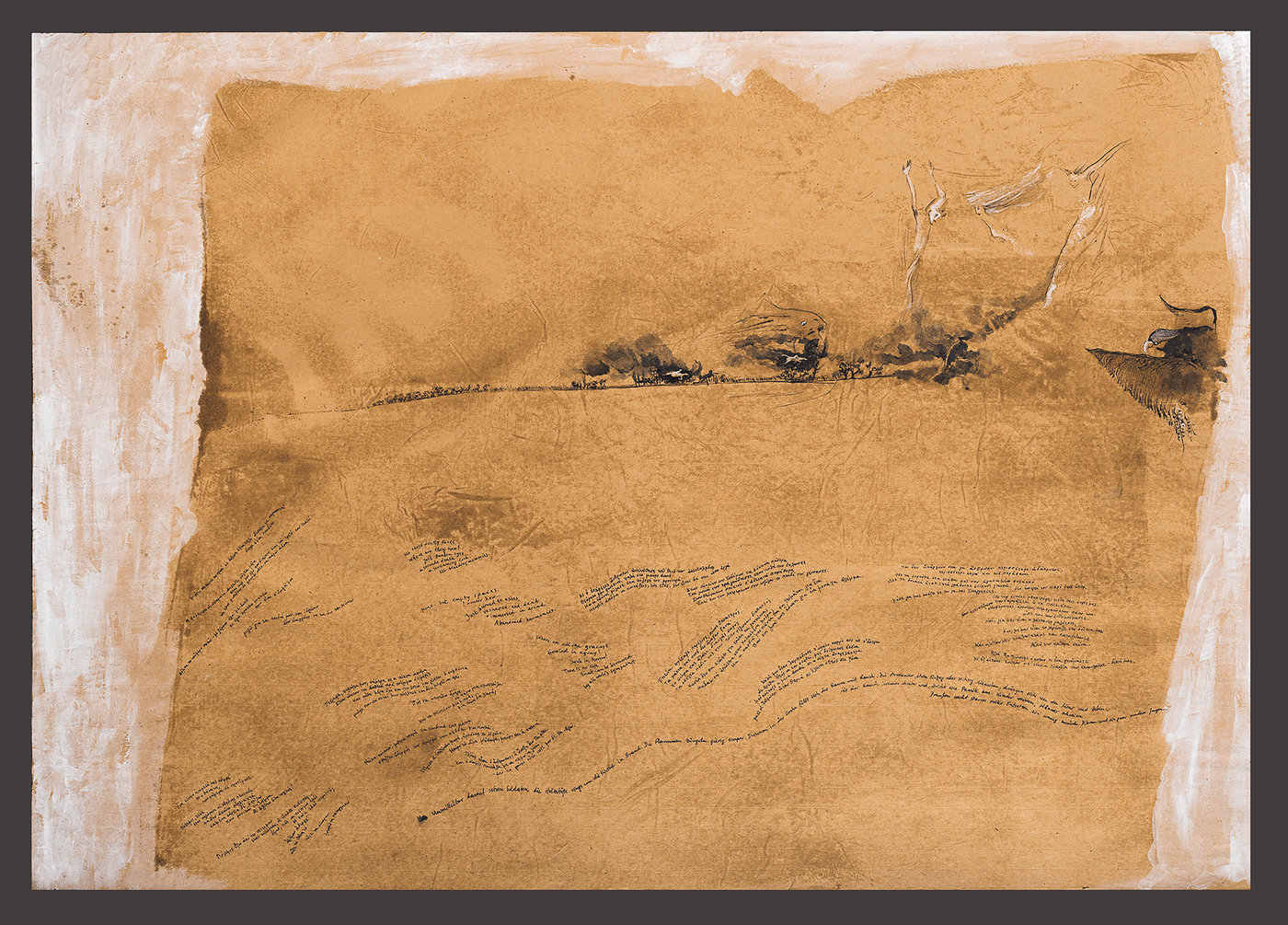
Thematic concepts
You leave your home out of a need to survive. Because you cannot abandon your need for freedom and self-determination. You want to be a citizen of the world, a free person, but your racial and ethnic characteristics follow you everywhere, a stigma that defines your place in society. You must fight both, for survival and for a reversal of your fate. The foreign land is not a homeland. It is a well in which you must work, careful not to fall in. You live in anxiety, in deprivation, fighting for dignity. You observe the lives of others and your losses become unbearable. You do not share the same culture, language, or values. You live in alienation. You leave your home and you are called a refugee. The society that receives you, still calls you this way.
Symbolism
A nearly floating image, moving awkwardly without a clear destination, much like the fate of refugees. Galloping horses, fleeing figures, faces of terror, and floating forms, souls of the departed who have yet to find peace, compose the procession of an anguished escape. In the sky, a predatory bird watches over, the inevitable companion of every exodus.
The texts include a prose piece by Elia Kazan, as well as poems and lyrics by Julika Psimouli, Anna Akhmatova, Angelos Simiriotis, and Giorgos Skourtis.
---
Desolation
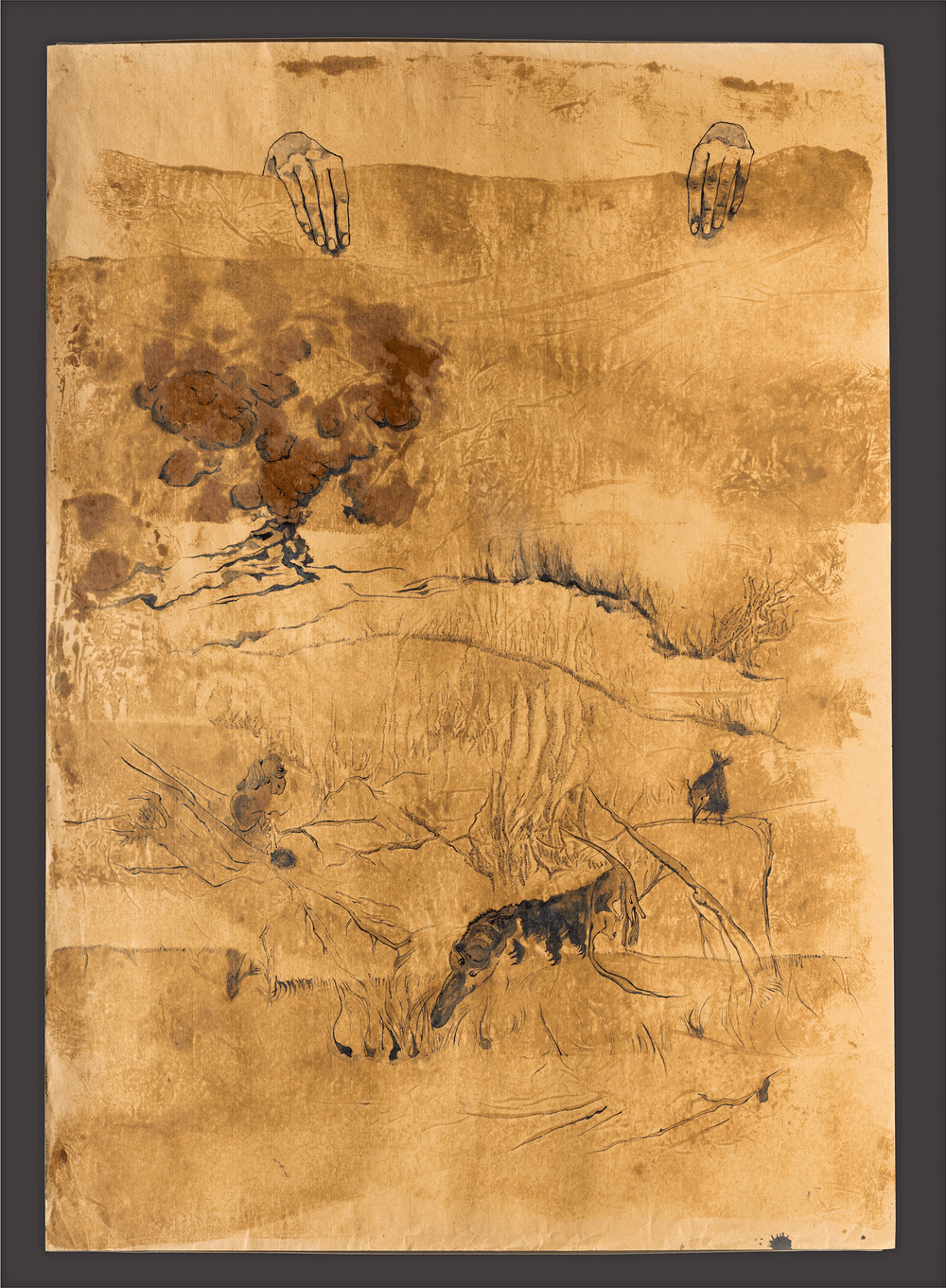
Thematic concepts
Humanity’s exploitative behavior towards nature and its life-sustaining resources gradually leads to desolation. Entropy, combined with this lack of respect, allows for different cycles of life, with altered rhythms and consequences that humans are increasingly unable to fully control, or perhaps even to observe. The degradation of nature is now proceeding at an uncontrolled, deadly rate. Living beings are trying to adapt to the new rapid changes, and so are humans. The consumption of the resources that nature has to offer is not subject to the logic of conservation and respect. Man is no longer able to manage not only the future, but also the present.
Symbolism
The fact that the eleventh piece of this collection has already been sold gave me the opportunity to present it in a different way, by creating a stitched work. This choice stems from the idea that clothing, much like the desecration of nature, is something we wear directly on our skin and, in turn, affects us deeply. The predatory behaviour of humans towards nature and the impending desolation, this work’s theme, concerns us all and affects us as intimately as the clothes we wear. Additionally, the process of stitching follows similar principles to the creation of a visual artwork, incorporating an element of randomness in the same way.
This specific garment is, next to its primary function of covering the body, an aesthetically refined, handmade piece that expresses simplicity, flexibility, and sustainability. The colour was chosen as a hue of light and reminiscent of hope but also as a symbol of nobility, serving as a counterbalance to the disrespect towards nature and our selfish, anthropocentric approach.
---
Petros Tatsiopoulos participates in the exhibition "the search of randomness" with the sound installation INST 4
INST 4
The sound installation in question is an attempt to combine algorithmic music composition with the deconstruction of the electroacoustic object/instrument, also known as the loudspeaker.
The composition has been written and produced using the SuperCollider programming environment, and as a musical mechanism, it is based on the variations of a three-dimensional probability set, which are selected stochastically with controlled randomness to generate sound events within spacetime.
The deconstruction of the speaker as an object and from this, the creation of a sculptural model has been achieved partly through the careful selection of materials, electromechanical and structural components, for sound reproduction, and the creation of an object with a different visual stimulus than that of a conventional speaker. It has also been achieved partly through tactics of random composition, as often encountered in abstract art.
Overall, the installation creates an irregular and at the same time regulated arrangement of «repetition and variation/ difference» of sound sources, which visually form an imaginary garden of sculptural elements and additively synthesized sounds out of sine and cosine waves.
Petros Tatsiopoulos
---
Petros Tatsiopoulos (born 1993) studied partially Architecture (KIT Karlsruhe, Germany), Scenography and Exhibition Design (HfG Karlsruhe, Germany) and has a BA Hons in Visual Arts (ACG Athens, Greece). He has participated in art projects such as theater scenography (Baden State Theater), artist-run spaces, group exhibitions, and festivals (InSonic 2015) and was also student in the CMRC Athens, Greece.
His main media are sound art, installation, sculpture, and painting with a focus on mathematical and philosophical abstraction.
His main research subjects are sculpture, music, sound art, programming and electronics, and his practice painting and unmediated performance.